Flextangle STEAM 美术项目
原文链接:https://createartwithme.com/flextangle-steam-art-project/
日期: 2018-03-13
作者: 米歇尔·伊斯(Michelle East)
分类: AP 工作室艺术(高中高阶美术)、美术教育博主网络、配色方案、色彩理论、彩铅课程、精选内容、高中美术、初中美术、美术原理课程、节奏与图案课程、STEAM 美术项目
标签: 美术 STEAM、美术 STEAM 课程、配色方案、配色方案工作表、色轮、flextangle、hexaflexagon、HEXAFLEXAGONS、高中美术、折纸历史、数学与美术、初中美术、纸面多边形雕塑、纸雕、图案、STEAM 项目、zentangle
Flextangle STEAM 美术项目:Flextangle——融合数学与美术
六边形折纸(Hexaflexagon)、配色方案与图案
初中与高中美术 STEAM 课程
壁挂式收纳袋制作说明:
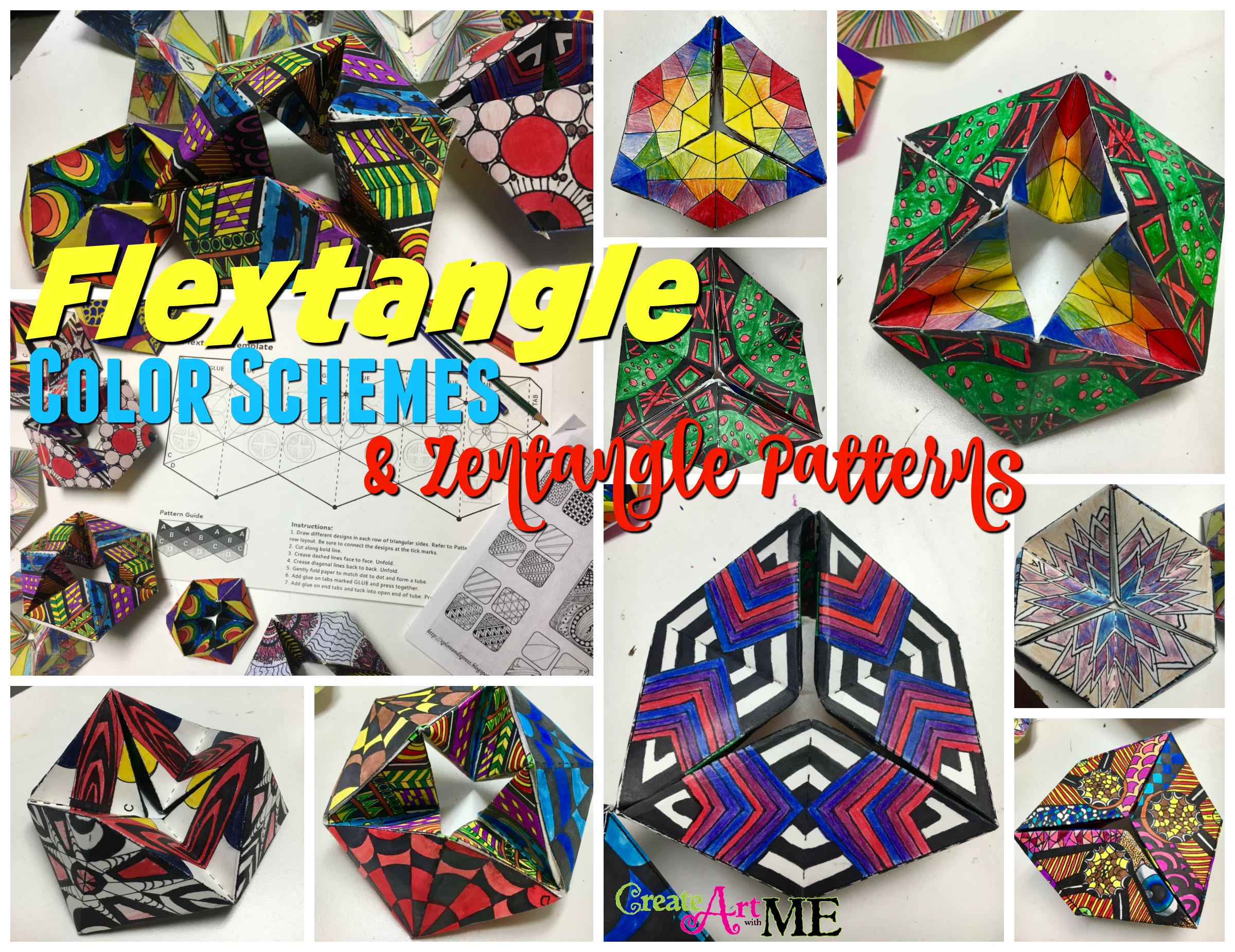
我最初是在 babbledabbledo.com 上看到 flextangle 的,觉得它非常适合作为一项 STEAM 美术项目——将数学性的六边形折纸(flexahexagon)纸雕与美术中的图案设计及色彩理论结合起来。我的高中美术 1 班学生将近期所学的 配色方案类型 知识,以及 Zentangle 图案技法,运用于创作这一引人入胜且令人上瘾的纸质多边形作品。六边形折纸制作起来趣味十足!学生们完成作品后便停不下来地反复“折叠”把玩!尽管本课例面向高中生开展,但只需简化设计要求,即可轻松调整为小学适用版本。根据边数与面数的不同,折纸模型有多种变体。以下图书提供了更多模板,可用于制作各类折纸:《奇妙折纸:六边形折纸及其他可扭转折叠的灵活结构》*


所需材料:
* A4 尺寸卡纸 或 90 磅 Ledger 尺寸 11×17 英寸、92 亮度(250 张)、Prismacolor Scholar 彩铅(60 色套装)、马克笔 和/或 Sharpie 记号笔、速干胶


*亚马逊联盟链接——仅推荐本人实际使用并喜爱的产品!
教学目标:
- 了解折纸的历史;
- 根据边数对多边形与多面体进行分类与命名;
- 掌握裁剪与折叠纸张的方法,制作出一种当外侧顶点被向中心推压时能旋转翻转的折纸模型;
- 运用等边且全等的三角形制作六边形折纸;
- 建立数学与美术之间的联系,并运用其解决问题;
- 通过动手实践,探究并分析三维几何体的属性。
课前准备: 将 Flextangle 模板 打印于 A4 尺寸卡纸(8.5×11 英寸)或 Ledger 尺寸卡纸(11×17 英寸)上。*我们先用 A4 纸做了简易练习版折纸,再在 Ledger 卡纸上完成最终版,并加入 Zentangle 图案设计。
下载并打印模板:https://babbledabbledo.com/wp-content/uploads/2015/03/Flextangles-Template-BABBLE-DABBLE-DO.pdf
教学实施:
数学部分
- 什么是 Flextangle? Flextangle 是六边形折纸(hexaflexagon)与 Zentangle 图案设计的结合体。
- 折纸(Flexagons): 在几何学中,折纸是一种平面纸模型——即纸制多边形,通常由折叠纸条制成。它们可通过特定方式“折叠”(flex)或弯折,从而展现多个不同面。当外侧顶点被向中心推压时,折纸模型即发生旋转。折纸常见形状为正方形、长方形(四边形折纸 / tetraflexagons)或六边形(六边形折纸 / hexaflexagons)。本课我们将制作六边形折纸。
- 折纸的命名规则: 折纸名称体现其形状与面数。“flexagon”一词前缀表示该模型可呈现的总面数(含未折叠时可见的正面与背面两个面)。例如,共具 六个面 的折纸称为六边形折纸(hexaflexagon)。
- 折纸的历史(资料来源:《六边形折纸及其他数学趣题:〈科学美国人〉首部谜题与游戏集》,马丁·加德纳著,芝加哥大学出版社)
- 折纸于 1939 年由 亚瑟·斯通(Arthur Stone) 发现。当时他是普林斯顿大学研究生,后成为曼彻斯特大学数学讲师。这位英国人将美国笔记本纸裁剪成适配其英国活页夹的尺寸时,灵机一动,将裁下的纸条折叠成各种图形,其中一种即为三面六边形折纸(trihexaflexagon)——因其具六边与三面而得名。他在此基础上进一步拓展,创造出六面六边形折纸(hexahexaflexagon)(六边、六面)。
- 斯通将其模型展示给朋友:布莱恩特·塔克曼(Bryant Tuckerman)、理查德·费曼(Richard Feynman)与约翰·W·图基(John W. Tukey),他们共同组建了 “折纸委员会”(Flexagon Committee)。
- 在几何学中,四面体(tetrahedron),又称三角锥,是由四个三角形面、六条直边与四个顶点构成的多面体。
美术部分
配色方案工作表合集(打包版)
- 复习 色轮;
-
-
互补色 是指在色轮上彼此正相对的颜色;
-
邻近色 是指在色轮上彼此相邻的 3–4 种颜色。
-
单色配色方案包含某一种颜色的浅色调与深色调。“Mono”意为“一”。
- 分裂互补配色方案包含一种颜色,以及该颜色互补色两侧的两种颜色。
- 三元配色方案包含色轮上彼此间距相等的三种颜色。“Tri”意为“三”。
- 禅绕画图案:禅绕画是一种艺术形式,仅需铅笔、绘图笔与纸张,并以放松专注的心态绘制基础重复图案(http://tanglingart.com/history-of-zentangle/)。禅绕画是注重图案与设计的精美艺术作品。
如何制作我们的可翻转立体纸模(flextangle):
- 下载并打印模板:https://babbledabbledo.com/wp-content/uploads/2015/03/Flextangles-Template-BABBLE-DABBLE-DO.pdf
- 每个区域顶部与底部各有一组对齐刻度标记(“tick” marks),用于帮助你将设计精准对齐于每个三角形区域内。折叠并翻转后,各区域的设计将组合成一个完整的图形。
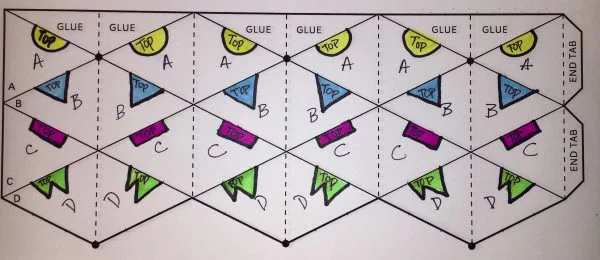
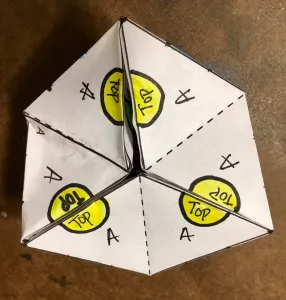
- 注意标有字母的独立区域 A、B、C 与 D。在每个区域内,你需绘制一个新设计,并在该区域内每个三角形中重复绘制同一设计。
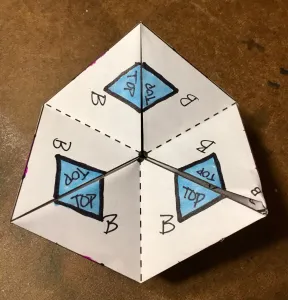
- 在区域 B 的每个三角形中绘制一个新设计并重复该设计。
- 在区域 C 的每个三角形中绘制一个新设计并重复该设计。
- 在区域 D 的每个三角形中绘制一个新设计并重复该设计。
- 选择一种将在全部四个区域中重复使用的颜色;再为每个不同区域分别选择一种配色方案(共四种)。示例如下:
- 重复使用的颜色:紫色
- 区域 A 配色方案:互补色 = 黄色 + 紫色
- 区域 B 配色方案:分裂互补色 = 紫色 + 黄绿色 + 黄橙色
- 区域 C 配色方案:类似色 = 紫色 + 红紫色 + 蓝紫色 + 蓝色
- 区域 D 配色方案:单色 = 紫色的浅色调与深色调(即不同明度)
可翻转立体纸模(flextangle)STEAM 艺术项目
活动:可翻转立体纸模(flextangle)多边形纸雕
可翻转立体纸模(flextangle)制作说明:
- 在每个区域(A、B、C 与 D)内分别绘制一个全新的禅绕画设计。**确保你的设计线条在每个区域顶部的“对齐刻度标记”处准确对齐或衔接。
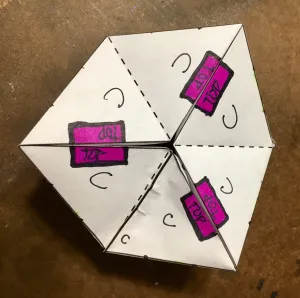
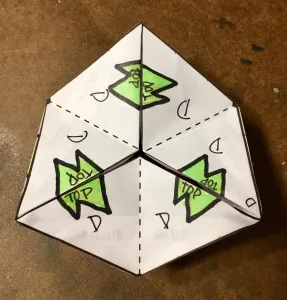
- 选择四种配色方案;其中一种颜色须在全部四个区域中保持一致。
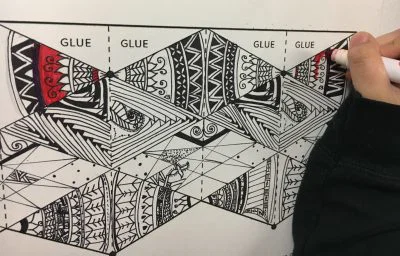
- 使用记号笔(Sharpie)、彩铅或马克笔,为每个区域分别应用一种配色方案上色。(本项目为单件作品,同时呈现 A、B、C 与 D 四个区域)
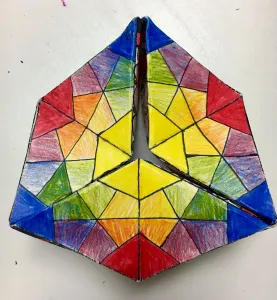
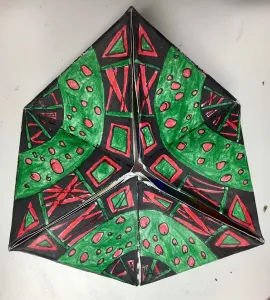
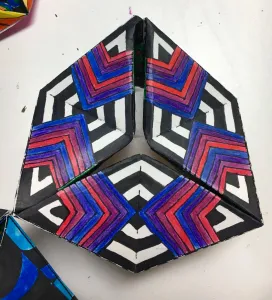
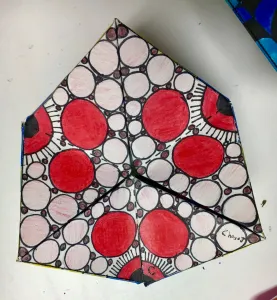
- 沿外轮廓的粗线剪裁。
- 借助直尺,将虚线处对折(使图案面朝图案面),随后展开。
- 借助直尺,将对角线处对折(使图案背面对图案背面),随后展开。
- 轻柔地将纸张对折(背面对背面),使圆点与圆点对齐,形成筒状结构。
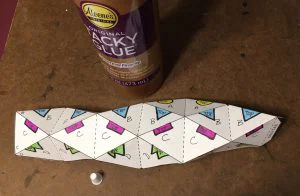
- 在标有“GLUE(粘贴)”的粘贴片背面涂抹白乳胶(tacky glue),然后压合固定。按压至纸张无需外力即可自行粘牢。
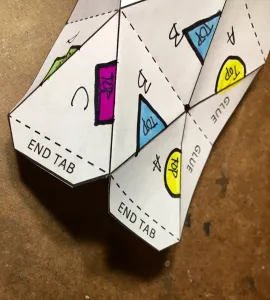
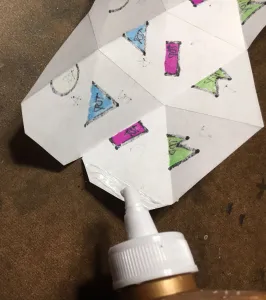
: 在末端粘贴片的背面涂胶
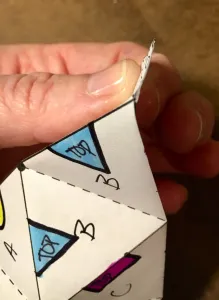
: 捏紧并按压保持
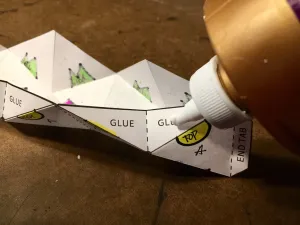
: 在标有“GLUE(粘贴)”的区域涂胶
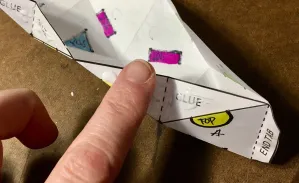
: 用手指均匀涂抹,覆盖整个粘贴区域
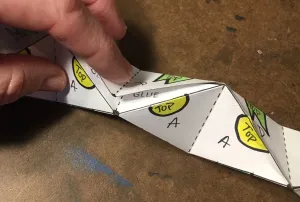
: 将圆点对圆点折叠,按压并保持
- 在末端粘贴片上涂抹白乳胶(tacky glue),将其插入筒状结构的开口端,按压并保持直至封口牢固。完全干燥后方可进行翻转操作。
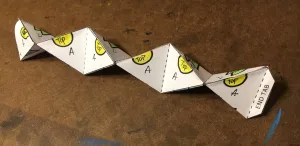
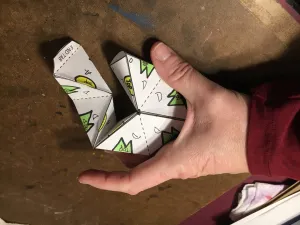
学生作品
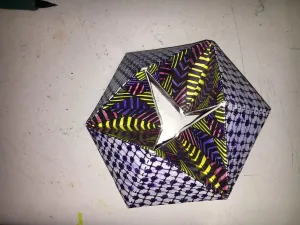
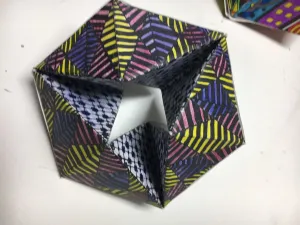
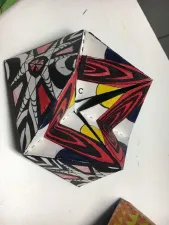
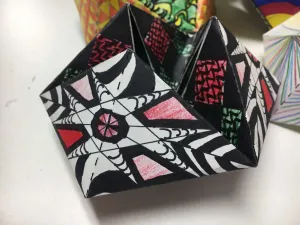
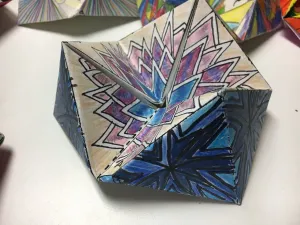
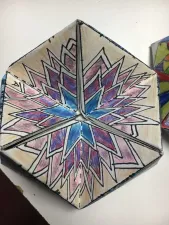
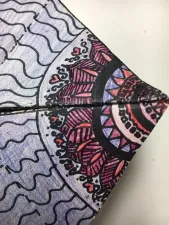
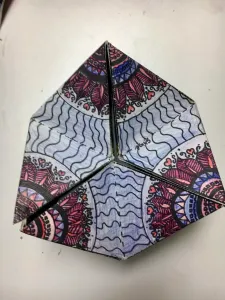

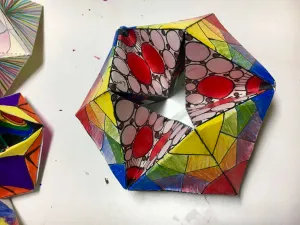

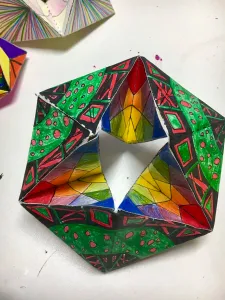


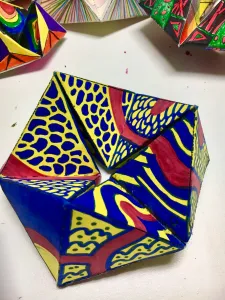
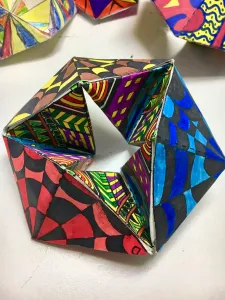
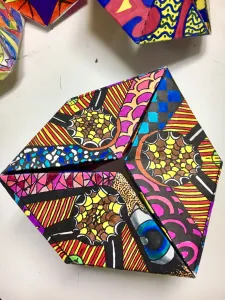
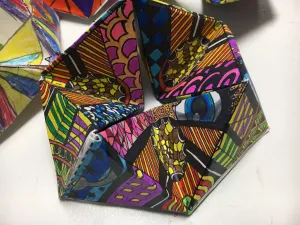
本月,美术教育博主联盟正围绕 STEAM/美术融合教学展开专题写作。欢迎每月第一个星期二加入我们,获取全新项目、创意与灵感。
参与的美术教师博客:
如您选用本博客中的任何内容(图片、图表或文字),请务必附上原文链接回指至 Create Art with ME!
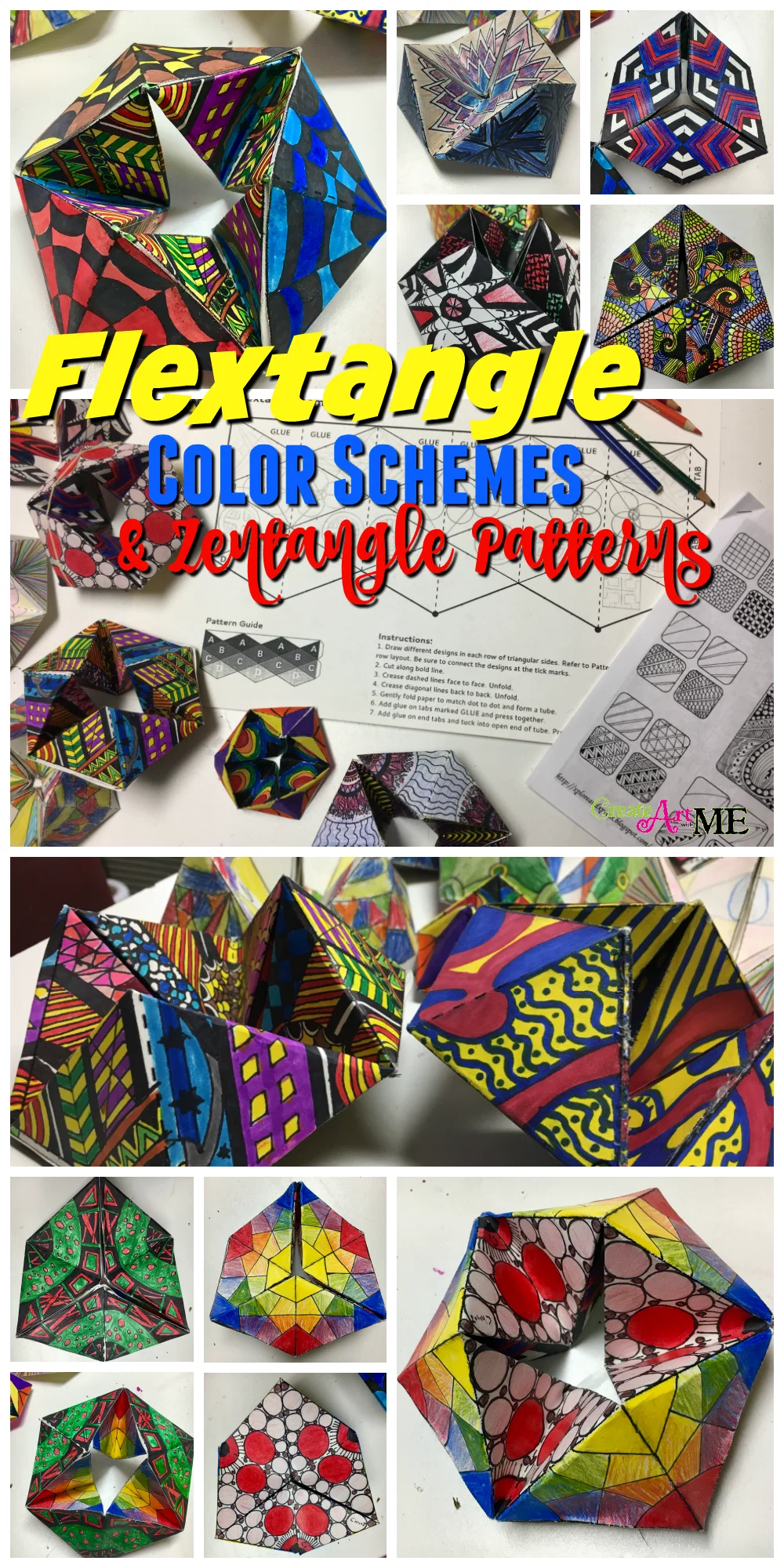
Flextangle STEAM Art Project
Original: https://createartwithme.com/flextangle-steam-art-project/
Date: 2018-03-13
Author: Michelle East
Categories: AP Studio Art (Advanced HS Art), Art Ed Blogger's Network, Color Schemes, Color Theory, Colored Pencil Lessons, Featured, HS Art, MS Art, Principles of Art Lessons, Rhythm & Pattern Lessons, STEAM Art Projects
Tags: art steam, Art STEAM Lesson, color schemes, Color Schemes Worksheet, color wheel, flextangle, hexaflexagon, HEXAFLEXAGONS, high art school, History of Flexagons, math and art, middle school art, Paper Polygon Sculpture, Paper Sculpture, pattern, STEAM project, zentangle
Flextangle STEAM Art ProjectFlextangle: Fusing Math and Art
Hexaflexagon , Color Schemes & Pattern
Middle School & High School Art STEAM Lesson
Wall Pocket Instructions:
I first saw flextangles on babbledabbledo.com and thought it would be a great STEAM Art project combining the mathematical flexahexagon paper sculpture and art patterns and color theory. My high school art 1 class applied our recent art lesson on types of color schemes along with Zentangle patterns to create this intriguing and addicting paper polygon. Flexahexagons are crazy fun to create. My students couldn’t stop flexing them after they made them! Even though this was done with high school, this lesson can be easily modified to elementary by simplifying the design requirements. There are MANY different flexagon designs depending on the number of sides and faces. This book provides some more templates for creating more varieties: Fantastic Flexagons: Hexaflexagons and Other Flexible Folds to Twist and Turn*
Supplies:* Letter size Cardstock or 90lb Ledger Size 11 x 17, 92 Bright (250 Sheets), Prismacolor Scholar Colored Pencils (60-Count), Markers and or Sharpies, Tacky glue
*Amazon Affiliate Links – I only link products I use and love!
Objectives:
- Learn the history of the flexagon.
- Classify and name polygons and polyhedrons based on the number of sides.
- Demonstrate understanding of how to cut and fold paper to create a flexagon that rotates when the outer points are pushed to the center.
- Create a hexaflexagon using equilateral, congruent Triangles.
- Make math and art connections and solve problems.
- Physically investigate and analyze the attributes of geometric 3-dimensional figures.
Preparation: Flextangle Template printed on Cardstock 8.5×11” paper or Ledger 11×17” Cardstock *We did a simple practice flexagon on letter size paper first, then created the final with Zentangle designs on Ledger cardstock paper.
Download and print template: https://babbledabbledo.com/wp-content/uploads/2015/03/Flextangles-Template-BABBLE-DABBLE-DO.pdf
Delivery:
MATH
- What is a Flextangle? A flextangle is a combination of a hexaflexagon and a zentangle design.
- Flexagons: In geometry, flexagons are flat models-paper polygons, usually constructed by folding strips of paper. They can be flexed or folded in certain ways to reveal the multiple faces. The flexagon rotates when the outer points are pushed to the center. Flexagons are usually square, rectangular (tetraflexagons), or hexagonal (hexaflexagons). We are creating a hexaflexagon.
- Flexagon Names: The name of a flexagon tells the flexagon’s shape and number of faces. A prefix is added to the name “flexagon” to indicate the number of faces that the model can display, including the two faces (back and front) that are visible before flexing. For example, a flexagon with a total of six faces is called a hexaflexagon.
- History of Flexagons (Resource: HEXAFLEXAGONS AND OTHER MATHEMATICAL DIVERSIONS: The First ‘Scientific American’ Book of Puzzles and Games by Martin Gardener University Of Chicago)
- Flexagons were discovered in 1939 by Arthur Stone, then a graduate student at Princeton University who later became a lecturer in mathematics at the University of Manchester. An Englishman, Stone was trimming American notebook sheets to fit in his English binder when it occurred to him to fold the strips of paper to make figures, one of which was the trihexaflexagon (so called because it has six sides and three faces). He elaborated on this model to create the hexahexaflexagon (six sides, six faces).
- Stone showed his models to his friends: Bryant Tuckerman, Richard Feynman, and John W. Tukey. They formed the Flexagon Committee.
- In geometry, a tetrahedron, also known as a triangular pyramid, is a polyhedron composed of four triangular faces, six straight edges, and four vertex corners.
ART
Color Schemes Worksheets PACKET BUNDLE
- Review Color Wheel.
-
-
Complementary colors are colors that are directly opposite from each other on the color wheel.
- Analogous colors are 3-4 colors that are NEXT to each other on the color wheel.
- Monochromatic color scheme includes the tints and shades of ONE color. “Mono” means one.
- Split complementary color scheme includes one color plus the two colors on either side of the color’s complementary color.
- Triadic color scheme includes THREE colors that are EQUAL distance from each other on the color wheel. “Tri” mean three.
- Zentangle Patterns: Zentangle is an art form that requires a pencil, pen, and paper and a relaxed focus on creating basic repeating patterns (http://tanglingart.com/history-of-zentangle/). Zentangles are beautiful pieces of art that focus on pattern and design.
How to make our flextangle:
- Download and print template: https://babbledabbledo.com/wp-content/uploads/2015/03/Flextangles-Template-BABBLE-DABBLE-DO.pdf
- Each section has two sets “tick” marks (at the top and at the bottom of each triangle) to help you line up your design within each section. When it is folded and flexed the design will come together to form a completed shape.
- Notice the individual sections A, B, C, & D. In each section you will draw a new design. You will be repeating the same design in each triangle of each section.
- Draw a NEW design and repeat the design in each triangle of section B.
- Draw a NEW design and repeat the design in each triangle of section C.
- Draw a NEW design and repeat the design in each triangle of section D.
- Choose one color that you will repeat in all four sections. Choose four color schemes to use-one in each different section. Here is an example:
- Repeated color: Purple
- Section A Color Scheme: Complementary= Yellow + Purple
- Section B Color Scheme: Split-Complementary=Purple + Yellow-green + Yellow-orange
- Section C Color Scheme: Analogous=Purple + Red-purple + Blue-purple + Blue
- Section D Color Scheme: Monochromatic= Tints and Shades (Values) Purple
Flextangle STEAM Art Project
Activity: Flextangle Paper Polygon Sculpture
Flextangle Instructions:
- Draw a NEW Zentangle design in EACH Section (A, B, C, & D). **Make sure your design lines up or connects at the TOP “tick marks” of each section.
2. Choose 4 Color Schemes to use. Have 1 color that is the same in all 4 sections.
3. Use Sharpie, colored pencils, or markers to color each section with a different color scheme. (This is a single project showing A, B, C & D Sections)
4. Cut along outer perimeter’s BOLD line.
5. Use a ruler to help fold the dashed lines face to face (design to design). Unfold.
6. Use a ruler to help fold the diagonal lines back to back. Unfold.
7. Gently fold paper back to back to match dot to dot and form a tube.
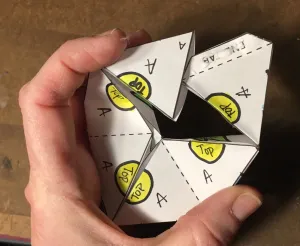
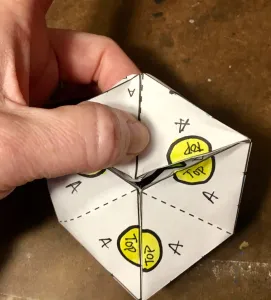
8. Add tacky glue on tabs marked “GLUE” and press together. Hold until the paper sticks without help.
: Put glue on the BACK of the END tabs
: Pinch & Hold
: Put glue on GLUE sections
: Spread with finger to cover entire section
: Fold DOT to DOT, Press & Hold
9. Add tacky glue on END tabs and tuck into open end of tube. Press and hold to seal. Let dry completely before flexing.
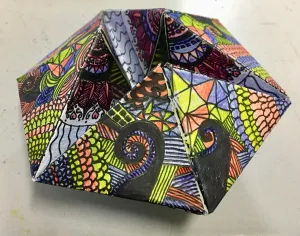
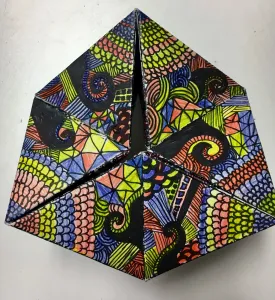
Student Artwork
This month, The Art Ed Blogger’s Network is writing about STEAM/Art Integration. Join us on the first Tuesday each month for new projects, ideas, and inspiration.
Participating Art Teacher Blogs:
If you choose to use ANY part of this blog (graphic, pictures or written text), please link back to Create Art with ME!


