夜色倒影蜡笔防染画
原文链接:https://tabithaannthelostsock.blogspot.com/2013/01/water-reflection-crayon-resist.html
日期: 2013-01-09
标签: 艺术、山城、蜡笔防染、鸭子、教案、夜景城市风光、对称、梵高、水面倒影、水彩
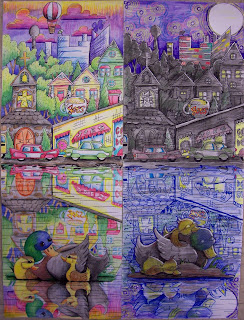
这是一项进阶型蜡笔防染夜景城市倒影作业(先深呼吸一下)
我计划将来带学生完成此练习。
它可能略显技术性,但我自己尝试时乐在其中。
也可将画面一分为二,仅聚焦于蜡笔防染技法表现夜间灯火,以及通过城市建筑的重叠营造视觉透视效果。
倒影部分可省略不画。
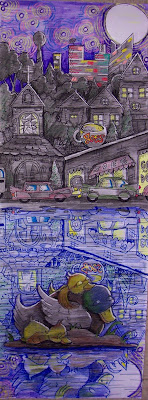
首先,用铅笔绘制一座层叠错落的山城。
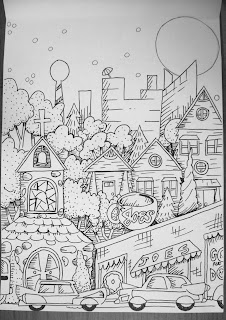
再用记号笔勾勒轮廓。
教学中可联系摩西奶奶(Grandma Moses)或格兰特·伍德(Grant Wood),讨论他们如何描绘自己熟悉的城市与生活;二人均有类似作品——城镇形象随距离推远而渐次缩小。
若需包含倒影部分,
请选定一种漂浮或静置于水面之物
(如睡莲叶上的青蛙、筑坝的河狸、探出水面的鸭嘴兽,或其他任意选择)。
我选了酣睡的鸭子。
(目前我也正在制作同一构图的日间版本,此时鸭子是醒着的。
稍后会发布。)
用铅笔绘制,再以记号笔勾线。
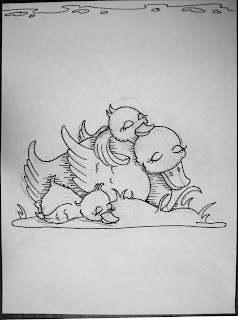
将水中物体向下对折,沿折痕用铅笔描摹其倒影轮廓。
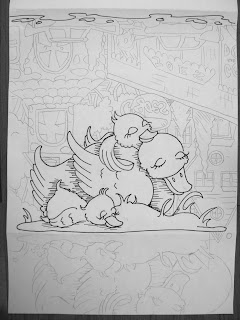
待水中漂浮物的倒影描摹完毕,再将山城图像整体转印至含水面倒影的画纸上;注意:漂浮物所占区域内的山城部分不可描摹。
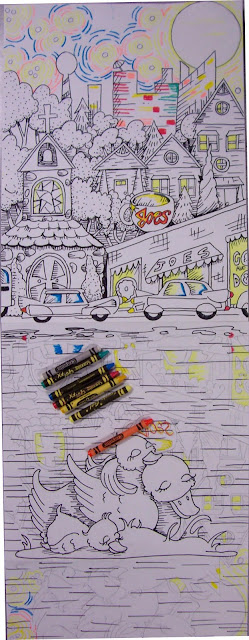
使用彩色卡纸蜡笔,以白色和黄色涂绘窗户;亦可添加少许更明亮的色彩表现夜间招牌,增添视觉活力。
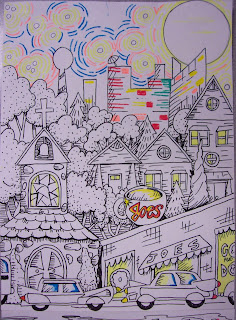
受梵高《星月夜》启发,
我在天空所有光源周围添加了放射状轮廓线。
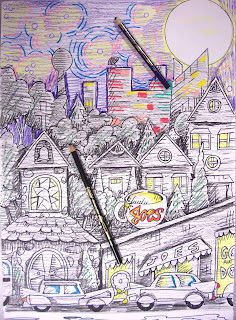
接着,我用Crayola水彩铅笔轻扫整座城市区域
(直接覆于蜡笔层之上,蜡笔层将产生防染效果)。
仅选用冷色与深色:建筑用黑色、天空用紫色、树木则以绿色混入黑色绘制。
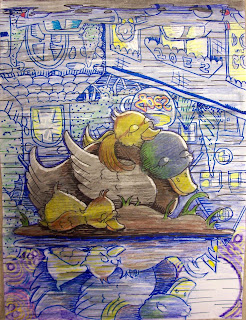
我用蓝色记号笔勾勒水面倒影轮廓。
同时,也用蜡笔为水中窗户倒影上色。
鸭子以黑色铅笔排线塑造明暗,并在较深的缝隙处加重刻画。
随后以黑色水彩薄涂覆盖,之后再用彩铅为鸭子局部添色。
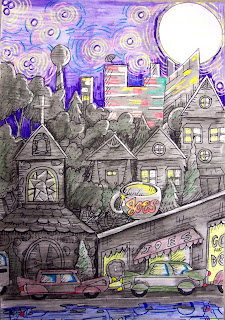
最后,用画笔蘸清水通体罩染全画,注意避免天空色彩与建筑色彩相互晕染。
以下是一则更简化的日间倒影教案……
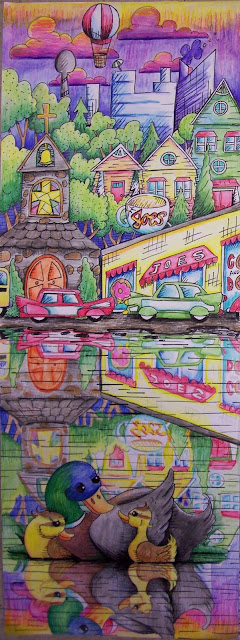
起始的绘画与描摹步骤基本相同。
本例不采用蜡笔防染法。
上方城市部分先用记号笔勾线,再平涂水彩;水彩干后,我另用彩铅加强暗部、提升对比度,使画面更“跳脱”。
倒影部分同样用水彩平涂,但未用记号笔勾边;而是改用彩铅勾勒倒影中建筑边缘,获得柔和清晰的效果,避免生硬黑线。
再于水面添加数条横向记号笔短线,模拟微澜波纹。
本教案灵感源自艺术家凯西·霍瓦特(Kathy Hovart)……
你或许想搜索了解她——她非常出色!
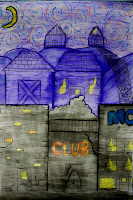
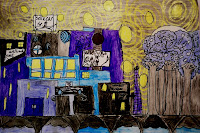
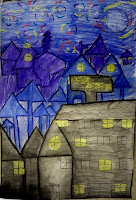
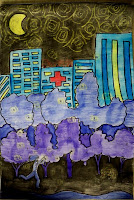
以下是我为七年级学生调整过的简化版教案,去除了倒影环节……
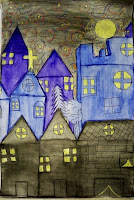
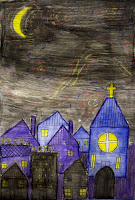
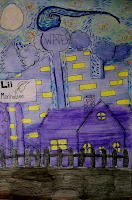
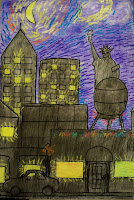
若想了解我为六年级学生设计的更简易倒影技法,
请访问我校网站:
http://classroom.mineolaisd.net/default.aspx?Mrs. Tabitha Seaton/Water Reflection Resist
夜色倒影蜡笔防染画
Original: https://tabithaannthelostsock.blogspot.com/2013/01/water-reflection-crayon-resist.html
Date: 2013-01-09
Tags: art, city on hill, crayon resist, ducks, Lesson Plan, night city scape, symmetry, van gogh, water reflection, watercolor
This is an advanced crayon resist NightCityScape Reflection assignment (take a breath)
that I plan on doing with my kids someday.
It may be a little too technical, but I had fun doing it myself.
It could be busted into half a painting just focusing on the crayon resist method of the night lights and overlapping of the city to show visual perspective.
The reflection piece could be left out.
First I drew an overlapping city on a hill.
Draw in pencil, outline in Sharpie.
This could be linked by talking about Grandma Moses or Grant Wood and how they showed their towns and life as they knew it. Both of them have similar paintings of towns shrinking in the distance.
If reflection portion of assignment is desired,
choose something to float or sit in the water
(frog on a lily pad, beaver and dam, platypus peeking out, or anything desired).
I chose ducks sleeping.
(I am also doing a day version of this currently and the ducks are awake.
I will post this later.)
Draw in pencil, outline in Sharpie.
Fold under the object in water and trace with and trace the reflection of object in pencil.
After the floating image is traced, then trace the image of the city on the hill to paper with water reflection, avoiding tracing city in any part of the floating object.
Use construction paper crayons to color windows in with white and yellow. Some brighter colors can be added to night signs as well for pizzazz.
Inspired by VanGOgh's Starry Night as well,
I added radiating contour lines around all the lights in the sky.
I then lightly shaded in all of the city life with Crayola Watercolor Pencils
(right on top of the crayon, it will resist the color).
I only used cool and dark colors (black for buildings, purple for sky, and some green for trees with black mixed in).
I used a blue sharpie to outline the reflection in the water.
Then I used the crayons in the reflections of the windows in the water as well.
I shaded the ducks in with black and went heavier on the darker crevices.
I washed over the black watercolor, then later came back with colored pencils to add in some color to ducks.
I then used the brush and water to go over the entire picture with a wash being careful not to mix the sky color with the buildings.
Here is a slightly less tedious lesson for another reflection done as the daytime...
The beginning drawing and tracing is basically started the same.
This is not a crayon resist.
The top city is traced with Sharpie and watercolored. I did add some emphasis after the watercolor using colored pencils to deepen the shades and make it "pop".
For the reflection, I also watercolored it the same as above, but instead of tracing it with Sharpie, I used the colored pencils to give the edges of the buildings in the reflection a little sharpness, without the harsh black.
I then added horizontal sharpie lines to the water to make it appear slightly rippled.
I was inspired by the artist Kathy Hovart before doing this assignment...
You may want to look her up. She is amazing!
Here is the altered lesson i tried with my kids 7th grade, leaving out the reflection aspect...
To see a simpler reflection method I do with 6th graders,
visit my school site here...
http://classroom.mineolaisd.net/default.aspx?Mrs. Tabitha Seaton/Water Reflection Resist


