音乐乐器与构图水彩绘画课
原文链接:https://createartwithme.com/music-instruments-composition-watercolor-painting-lesson/
日期: 2017-02-26
作者: Michelle East
分类: AP Studio Art(高中高阶美术)、美术课程、构图课程、精选内容、高中美术、绘画课程、水彩课程
标签: 构图骨架(composition armature)、构图结构类型、音乐乐器、音乐乐器与构图水彩绘画课、艺术中的音乐乐器、构图艺术类型、构图结构类型、水彩绘画课
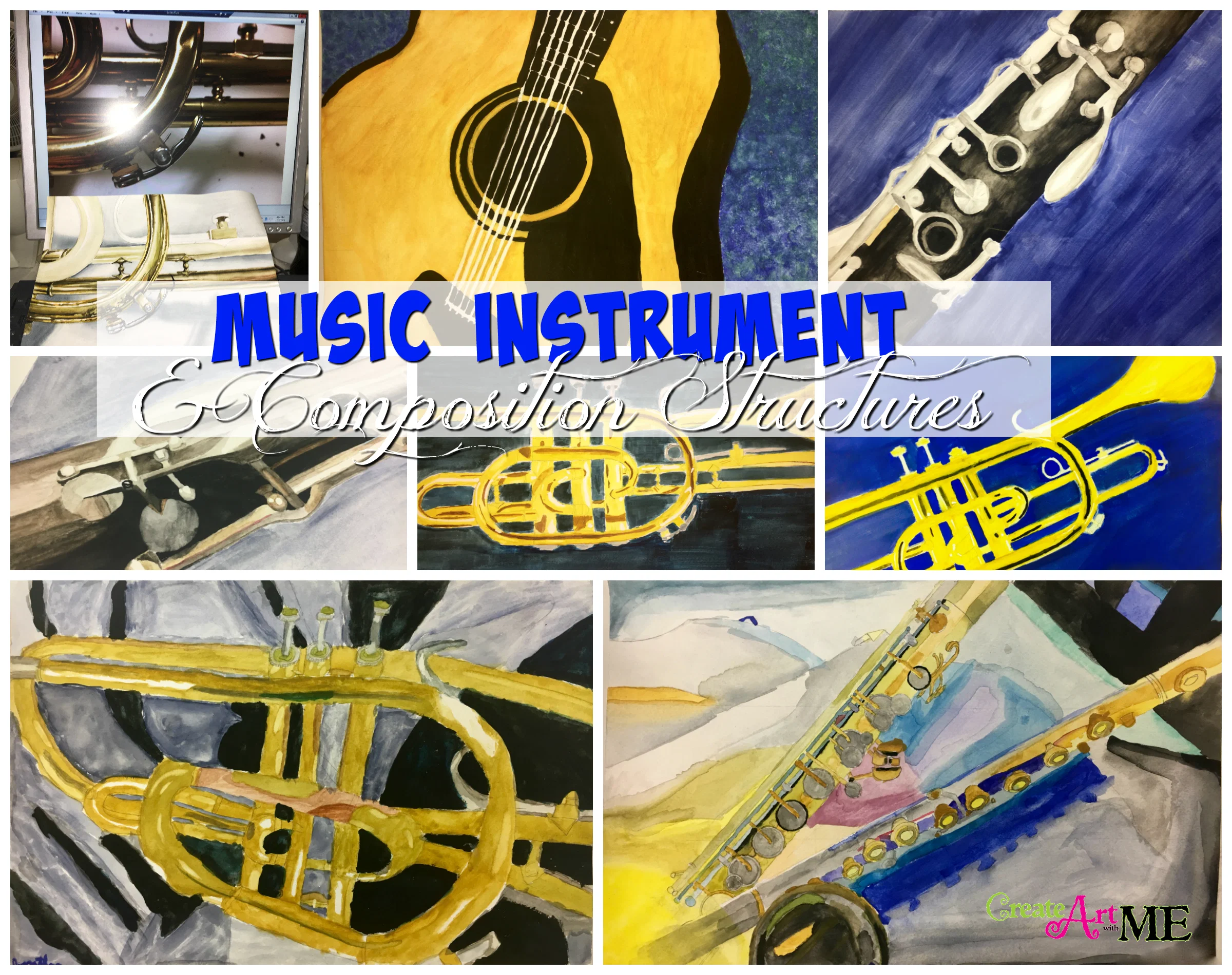
我的高中美术课学生,美术经验水平参差不齐。 其中有些学生从未上过美术课,也有些则从小学起就持续学习美术。这种经验差异使课程设计变得极富挑战性。我既要为“零基础新手”提供扎实的技法指导,又要为中等水平学生设置足够挑战性的任务。我的AP美术班学生并未参与本项目(尽管我真心希望他们能参加)。
于是,我向学校管乐队指挥老师提出请求,能否借用一些乐器用于拍摄照片——他欣然应允!学生们自主设计构图、自行拍摄并编辑照片;随后将构图草图转绘到水彩纸上,运用我们已掌握的基础技法进行水彩创作(平涂、渐变及留白胶“保护高光”)。本项目成果涵盖极初级水平(第二幅美术作业)至中等水平的高中生。他们仍在夯实素描能力与水彩技法,但即便在当前阶段,已展现出显著进步。
关于构图的优质参考资料:
《精通构图》(Ian Roberts 著)
《画家的设计与构图指南》(Margot Schulzke 著)


教学目标:
- 定义视觉艺术中的“构图”
- 定义“强调”(即视觉焦点),观察其在视觉艺术中的应用;识别在二维艺术作品中营造强调效果的六种方式
- 定义“裁剪”,理解有选择地裁剪图像对引导观众聚焦于视觉焦点的重要性
- 识别六种作为构图骨架(armature)的构图结构
教学实施:
- 什么是构图?为何它对一件艺术作品至关重要?
- 定义: 构图指作品的整体组织方式,即艺术家如何有意识地运用美术的造型元素与形式原理来构建作品。
-
重要性: 画面中各物象的位置安排绝非随意之举,而是经过深思熟虑的决策结果。作为艺术家,你的职责是引导观众进入画面,并在其间游走。你必须有意识地运用造型元素与形式原理,确立视觉焦点、营造氛围、提供视觉动线,从而帮助观众理解并体验你的画面。
-
什么是强调(视觉焦点)?
《北光艺术术语词典》将视觉焦点定义为画面中的兴趣中心。
-
营造强调效果的六种方式:
- 位置(三分法)
- 色彩对比
- 尺寸对比
- 形状对比
- 肌理对比
- 孤立(孤立处理)
- 讨论并展示体现上述六种强调方式的艺术作品范例
-
裁剪: 可将裁剪理解为去除图像中多余或不必要部分的行为,以帮助观众聚焦于视觉焦点,甚至辅助叙事。
-
构图结构: 一种组织画面中各造型元素的方法。可将结构比作动物或人体的骨骼——它是支撑整体形态的“骨架”。描述该结构的另一术语是“骨架”(armature)。构图结构类型繁多(远不止以下六种),但本课仅聚焦于此六类。 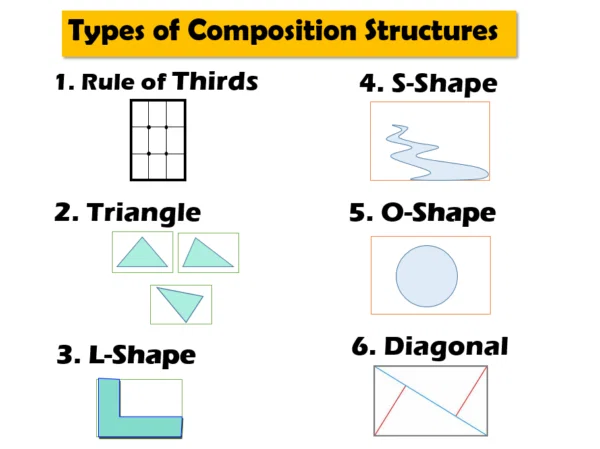
-
构图结构类型(骨架):
-
三分法: 将纸面或画布在水平与垂直方向均三等分,四条分割线相交形成四个交点,称为“视觉焦点”。兴趣中心应置于其中任一交点处。
-
三角形: 主要物象大致按三角形或金字塔形排列。 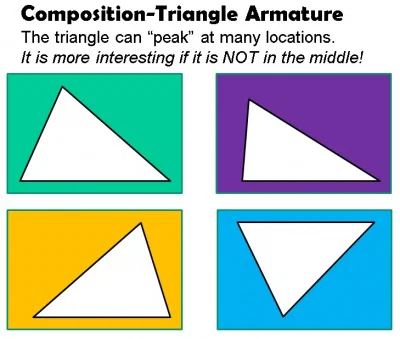
-
L形: 常见于风景构图。主体、主物或垂直体量强烈占据画面一侧,底部则由横向基底构成“L”形。此类构图通常并非单个物体,而是多个物象共同组合形成的强“L”形结构。视觉焦点可设于侧边的主垂直物象上,亦可设于“L”所围出的开放空间内。由于该构图具有鲜明的垂直线与水平线,因而传递出宁静与安详之感。
-
S形: 同样常见于风景构图。此设计需绘制一条蜿蜒曲线,且大部分弯曲应集中于画面底部。此举可打破画面呆板感,“S”形线条将自然吸引观者视线进入画面,并引导其视线穿行于整幅作品之中。通常用以将注意力导向构图焦点。物象整体呈字母“S”状,构图流畅而优雅。此类型尤其适用于表现河流蜿蜒、林木起伏等风景题材。视觉焦点常位于“S”形末端。
-
圆形: 此类构图中,物象、造型、明度与线条均围绕一个“O”形布局展开。视觉焦点置于该“O”形中心。
-
对角线构图: 主要构图沿一条强劲的对角线(蓝色线条)绘制,该线从一个角延伸至对角的另一个角。由此向外延伸、通常与主对角线呈90度角的线条(红色线条)则指向其余两个角。视觉焦点即为这些相交线条的交汇处。
i. http://erickimphotography.com/blog/2013/10/10/street-photography-composition-lesson-3-diagonals/
ii. http://muddycolors.blogspot.com/2013/12/a-baroque-composition.html
活动#1:速写本作业——构图类型速写:
用铅笔和直尺将速写本页面均分为6个区域。在每个区域顶部标注以下标题:三分法、三角形、L形、S形、圆形、对角线。在每个区域内绘制一幅草图,以图示方式表现该种构图结构。(无需明暗/排线)媒介: 绘画铅笔
课前技法练习工作表:
教师范例
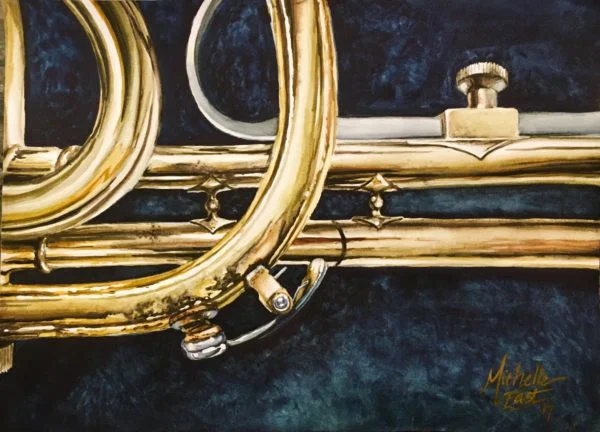
© Michelle East 2017
项目:乐器主题与构图水彩绘画
项目目标: 运用我们所学六种构图结构中的任意一种,创作一幅富有动感的音乐主题构图。通过布光与选择性裁切营造视觉趣味。
参考艺术家Jenny Armitage的乐器水彩绘画作品
操作步骤:
- 摆放1–3件乐器,使其符合六种构图结构中的一种。
- 以富有趣味的方式布置光源于该乐器组合上。
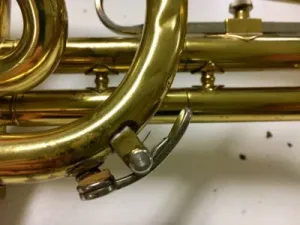
- 使用iPad 拍摄该构图照片,注意裁切画面,确保所呈现的乐器部分不超过其整体的四分之三。
- 确保构图中设有视觉焦点,并将其置于所选构图结构的恰当位置。
- 使用Photoshop Express应用程序编辑你最喜爱的照片。
- 打印出该照片。
- 用极轻的线条将构图转绘到水彩纸上。 清除所有较重的铅笔痕迹(否则会在水彩覆盖后显露出来)。
- 用水彩完整绘制整幅构图。 需呈现完整的明度范围,包含高光与投影。
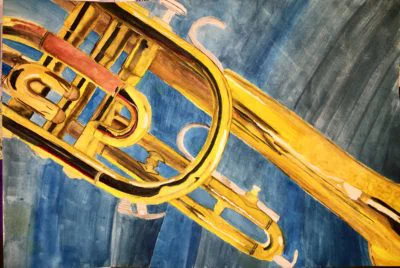
部分学生作品:
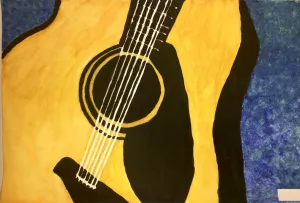
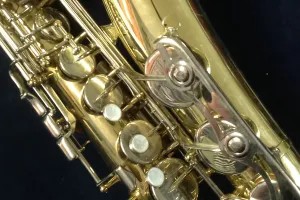
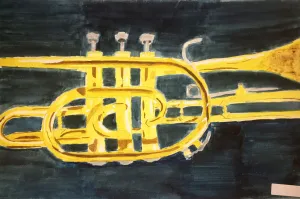
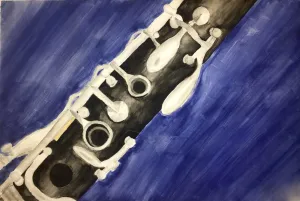
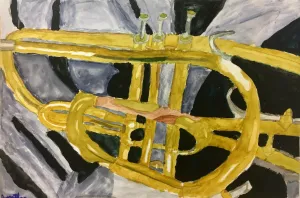
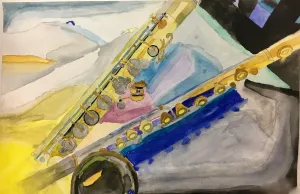
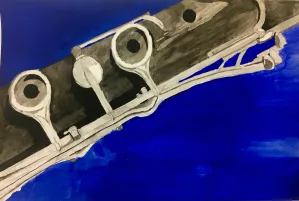
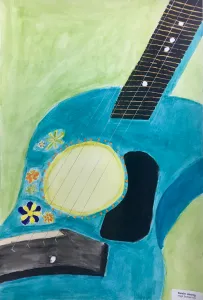
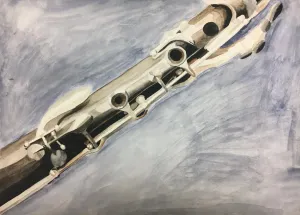
本教案由Michelle C. East撰写。若您选用本教案中的任何文字或图片,请务必回链至本博客Create Art with ME!
Music Instruments and Composition Watercolor Painting Lesson
Original: https://createartwithme.com/music-instruments-composition-watercolor-painting-lesson/
Date: 2017-02-26
Author: Michelle East
Categories: AP Studio Art (Advanced HS Art), Art Lessons, Composition Lessons, Featured, HS Art, Painting Lessons, Watercolor Lessons
Tags: composition armature, Composition Structures, Music Instruments, Music Instruments and Composition Watercolor Painting Lesson, Music Instruments in art, types of Composition art, Types of Composition Structures, watercolor painting lesson
My high school art classes are mixtures of different levels of experience in art. I have several that have NEVER taken art before and then some who have taken it all their lives. These varying experience levels make it VERY difficult to plan lessons. I want to give good technique instruction to the “newbies” and yet provide challenges to the mid-level students. My AP Art students did not work on this project (although I wish they had).
So, I went to our band director and asked if would could borrow some instruments for a photo shoot and he graciously agreed! The students arranged their own compositions, took their own photos and edited them. They drew the compositions onto watercolor paper and painted using the basic skills we had learned (washes, gradations, & masking fluid to “save the whites”). The project as shown represents VERY beginner level (2nd art project ever) to mid-level high school art students. They are still getting a grasp on drawing skills and watercolor painting techniques but even in our current projects are showing good progress.
Excellent Resources on Composition: “Mastering Composition” by Ian Roberts & “A Painter’s guide to Design & Composition” by Margot Schulzke
Objectives:
- Define composition in the visual arts
- Define emphasis (focal point) and observe how it is applied to visual arts. Identify six ways to create emphasis in a 2D piece of art.
- Define is cropping and understand the importance of selective cropping to help the viewer to focus on the focal point.
- Identify six compositional structures as armatures for arranging a composition.
Delivery:
- What is composition, why is it important to a piece of art:
- What: Composition refers to how the artwork is put together. It is how the artist INTENTIONALLY used the elements and principles of art to create the artwork.
- Why: The placement of objects within the picture plane is not an arbitrary act, but is the result of calculated decisions. It is your job as the artist to lead the viewer into and around your composition. You must use the elements and principles of art intentionally to create your focal point, create mood, and give directional cues that will help the viewer navigate your picture.
- What is emphasis: The North Light Dictionary of art terms defines focal point as the center of interest in a picture.
- 6 Ways to create emphasis: Placement (Rule of Thirds), Contrasting color, Contrasting size, Contrasting shape, Contrasting texture, Isolation
- Discuss & view examples of artwork illustrating the 6 Ways to create emphasis
-
Cropping: Think of cropping as the act of cutting away unnecessary or unwanted portions of an image to help focus the viewer’s attention and even help tell a story.
-
Composition Structures: a method of arranging the elements in a composition. Think of the structure like a skeleton in an animal or person. It is the bone that the shape of the animal is built on. Another word to describe the structure is armature. There are many types of structures (more than the 6 listed here), but these are the ones we will focus on.
5. Types of Composition Structures (Armatures)
-
Rule of Thirds: Paper or canvas is divided into thirds both horizontally & vertically. The lines intersect at four points. These are called focal points. The center of interest is placed at one of the points.
- Triangle: The main objects are arranged roughly in a triangle or pyramid.
- L-Shape: Commonly used in landscape compositions. The main object, subject, or vertical mass lays heavily on one side and the bottom has a horizontal base forming the “L” composition. The composition generally is not only of one object but of many together that form the strong “L” shape. The focal point can the main vertical object on the side, or it can be in the open space created by the “L”. Because of the strong vertical and horizontal lines of this type of composition it creates a sense of peace and tranquility.
- S-Shape: Also common in landscapes. In this design, you create a winding line, preferably with most of the twist toward the bottom of the painting. This offsets the painting’s design, and the S-shape will draw your eyes into it. You can use it to guide a viewer’s eyes through the painting. Usually, you will use the S-shape to direct attention to the focus of the composition. The subjects form a shape similar to the letter “S.” The composition is fluid and graceful. This is a perfect type for landscapes where a river or trees flow through the drawing. The focal point is often at the end of the “S”.
- Circle: For this type, you draw your subjects, objects, values, and lines to form an “O.” Your focal point goes in the center of the “O.”
- Diagonal: The main composition is drawn along a strong diagonal line (blue line) going from one corner to the opposite diagonal corner. From that, extending out, often at 90 degrees from that main diagonal, were lines to the other corners (red lines). The focal point is where the intersecting lines meet.
i. http://erickimphotography.com/blog/2013/10/10/street-photography-composition-lesson-3-diagonals/
ii. http://muddycolors.blogspot.com/2013/12/a-baroque-composition.html
Activity #1:Sketchbook Assignment-Types of Composition Sketches:
Divide your sketchbook page into 6 sections with a pencil and ruler. Label the top of each section with these titles: Rule of Thirds, Triangle, L-Shape, S-Shape, Circle, & Diagonal. In each section sketch out a drawing that illustrates the use of that composition structure. (no shading) Medium: drawing pencils
Pre-Instruction Technique Worksheets:
Teacher Example
© Michelle East 2017
Project: Music Instruments and Composition Watercolor Painting
Project Objective: Create a dynamic composition of music using one of six composition structures we learned about. Use lighting and selective cropping to create visual interest.
View Instrument Watercolor Painting examples from the artist Jenny Armitage
Instructions:
- Arrange 1-3 instruments so that is conforms to one of the six compositional structures.
- Position lighting on the arrangement in an interesting way.
- Use your iPad to take pictures of the composition making sure to crop in so that no more than 3/4th of the instrument is showing.
- Make sure you have a focal point that is placed appropriately within the composition structure you chose.
- Edit any favorite photos using the Photoshop Express app.
- Print out the photo.
- LIGHTLY draw the composition onto watercolor paper. Erase any heavy pencil marks (they will show through the watercolors).
- Use watercolors to paint the entire composition. Include a full ranges of values with highlights and cast shadows.
Some Student Work:
This lesson plan was written by Michelle C. East. If you choose to use any of this lesson (written or photos), please link back to this blog Create Art with ME!


